

Analysis of Uzbekistan’s Progress in the Government AI Readiness Index
(2023–2025)
The Government AI Readiness Index, published annually by Oxford Insights, assesses countries’ capacity to implement and govern artificial intelligence (AI) technologies.
Through 2024, the index combined scores across three core pillars — Government, Technology Sector, and Data & Infrastructure — to produce a global ranking. In 2025, the methodology was updated and expanded: the number of indicators increased significantly, and the scope broadened from mere readiness for AI adoption in the public sector to encompass a country’s ability to govern, regulate, and strategically direct AI for the benefit of society and the economy as a whole.
Over recent years, Uzbekistan’s performance in this index has improved considerably — a reflection of the systematic reforms being carried out in the country in the areas of digital innovation and AI governance.
This report provides a detailed analysis of Uzbekistan’s development trajectory from 2023 to 2025, presenting annual results and regional comparative figures for each pillar. It also includes a visual analysis of key trends and ranking changes, and concludes with strategic recommendations aimed at further strengthening Uzbekistan’s AI readiness.
Overall Trend
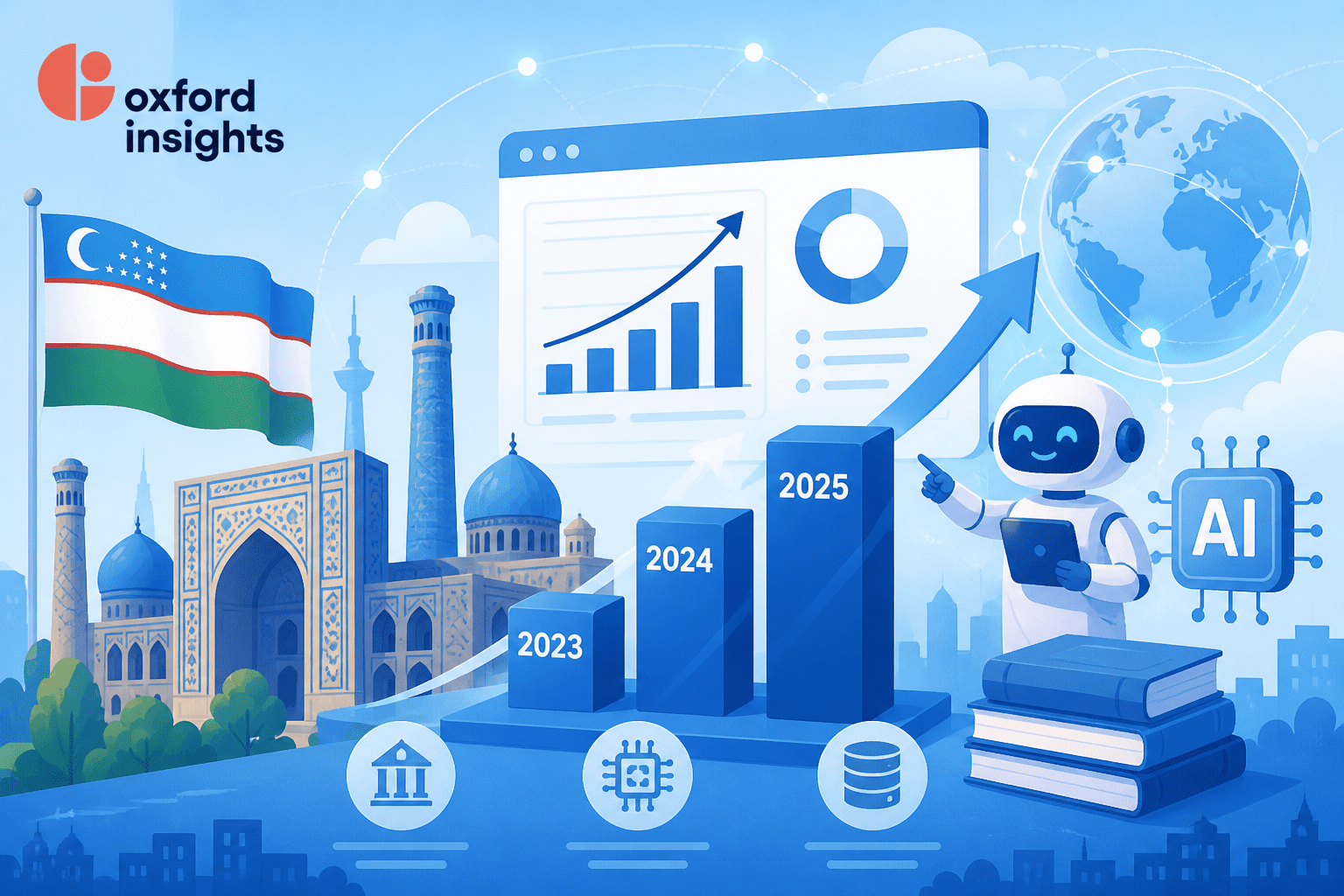
Between 2023 and 2025, Uzbekistan’s level of AI readiness rose sharply. Over this period, the country’s overall index score climbed from 43.79 to 54.69, and its global ranking improved from 87th to 62nd place — a jump of 25 positions.
This growth trajectory is clearly reflected in the table below:
Year |
Global Rank |
Overall Score |
| 2023 | 87 | 43.79 |
| 2024 | 70 | 53.45 |
| 2025 | 62 | 54.69 |
Table 1: Uzbekistan’s overall ranking and score in the Government AI Readiness Index, 2023–2025.
A steady year-on-year increase in scores is observed, with a particularly large leap recorded between 2023 and 2024. Notably, while score growth slowed somewhat in 2025 (by nearly one point compared to 2024), the country’s ranking continued to improve because other states progressed more slowly.
Key drivers of growth:
The data show that Uzbekistan achieved its greatest gains in the governance and strategy pillars, while growth in the technology sector capacity was more moderate.
- In 2024: Scores rose sharply following the formal adoption of a National AI Strategy and related reforms.
- In 2025: Uzbekistan achieved high results in policy and government capacity metrics (exceeding 80 points in some sub-categories), though it continues to lag in developing its technological ecosystem.
These patterns indicate that early improvements were driven by high-level government initiatives and infrastructure investment. Building a robust AI infrastructure, industry, and talent base remains an ongoing challenge.
Year-by-Year Analysis
2023: Baseline Assessment
In 2023, Uzbekistan ranked 87th globally with an overall score of 43.79, placing the country in the lower half of the global ranking. Analysis across the three core pillars revealed varied results:
Government Pillar — Score: 49.07 (moderate)
In 2023, Uzbekistan had a certain foundation in digital government and AI governance capacity, but no formal AI strategy existed at the time. The score reflected early efforts (such as initial AI policy drafts) alongside a clear need for a more defined national AI strategy. For comparison, neighbouring Tajikistan had already announced its AI strategy and scored higher in governance — 53.18 — highlighting Uzbekistan’s parity with some neighbours but its lag behind countries with more developed AI policy frameworks.
Technology Sector Pillar — Score: 24.80 (very weak)
This was Uzbekistan’s lowest score in 2023, indicating that the AI industry was nascent and human capital in the tech sector was limited. The low score reflected an underdeveloped innovation ecosystem and AI startup environment, as well as shortages of specialised talent and R&D activity. By comparison, Kazakhstan and Azerbaijan scored approximately 31 in this pillar in 2023, meaning Uzbekistan lagged even behind regional neighbours in technology sector readiness.
Data & Infrastructure Pillar — Score: 57.49 (relatively strong)
This indicated that Uzbekistan had a respectable foundation in digital infrastructure and data availability in 2023, thanks to prior investments in e-government, internet connectivity, and open data initiatives. However, this score still fell below global leaders — Russia, for instance, scored 71.26 in this pillar that year.
Summary (2023): Uzbekistan entered the 2023 index with moderate government digital capacity, a solid data infrastructure base, but a very underdeveloped AI technology sector. The country trailed major CIS states such as Russia (38th, 62.92) and Kazakhstan (72nd, 48.56), while outranking most other Central Asian nations. The situation clearly indicated the need for strategic intervention, particularly to improve the innovation and human capital ecosystem.
2024: National AI Strategy Announced — A Dramatic Rise in the Index
2024 proved to be a turning point for Uzbekistan’s AI readiness. The country climbed to 70th place globally with an overall score of 53.45 — a rise of 17 positions in a single year. This near-10-point improvement was among the largest positive gains worldwide during the year. Broad progress was recorded across all three pillars in 2024:
Government Pillar — Score: 64.71 (a sharp increase from 49.07 the previous year)
This leap reflected fundamental governance reforms, most notably the adoption of Uzbekistan’s first comprehensive National AI Strategy in 2023. Oxford Insights described Uzbekistan as one of the countries that had “worked on a draft in 2023 and formalised its AI vision during the current year.” Within the Government pillar, Uzbekistan achieved a perfect score of 100 in the “Vision” sub-indicator — well above the global average of 42.55 — signalling a clear strategic plan, strong political will, and serious attention to AI ethics and governance. As a result, Uzbekistan’s Government pillar score surpassed all its regional neighbours.
Technology Sector Pillar — Score: 33.50 (a notable increase of +8.7 points from 2023, though still relatively weak)
Crossing the 30-point threshold indicated early progress in building an AI ecosystem, likely driven by investment in IT education, startups, and research. Yet 33.5 remains well below the global average, and the gap between this pillar and the Government and Data pillars highlighted the continued challenge of AI talent shortages and limited private-sector innovation.
Data & Infrastructure Pillar — Score: 62.14 (moderate increase from the previous year)
This reflects gradual improvements in digital infrastructure and data policy. According to Oxford Insights data, Uzbekistan performed very strongly on data availability, scoring 84.05 in that sub-indicator (versus a global average of 59.81) — reflecting open data initiatives and wide-scale digitisation of government data. Broadband and ICT infrastructure also expanded in 2024, though AI-specific infrastructure such as high-performance computing and GPU clusters remained in the early stages of development. Overall, Uzbekistan nearly drew level with regional leaders like Kazakhstan (65.93) in this pillar.
Regional Standing (2024): Uzbekistan’s positive changes made it the leading country in AI readiness in Central Asia in 2024. Within the South and Central Asia region, it ranked 3rd — behind India and Turkey. With 53.45 points it trailed Turkey (60.63) and India (62.81) but was well ahead of its neighbours. Notably, Uzbekistan overtook Azerbaijan, which had fallen to 111th place due to the absence of a formal AI strategy.
Summary (2024): Uzbekistan’s National AI Strategy and governance reforms elevated the Government pillar to a new high, which in turn drove an overall ranking increase. By the end of 2024, Uzbekistan had entered the world’s top 70 and was recognised as a country that had “demonstrated its commitment to creating the foundational governance systems needed to improve AI readiness.” The weakness in technology sector scores pointed to the next objective: moving from policy strategies to practical outcomes — building advanced AI infrastructure and a skilled talent base.
2025: Continued Rise in the Global Ranking
In 2025, Uzbekistan maintained its positive trajectory, climbing to 62nd place globally with an overall score of 54.69. While the score increase was smaller than in the previous year (+1.24), the country still rose another 8 positions — evidence that Uzbekistan is holding its pace in an increasingly competitive field.
It is worth noting that in 2025, Oxford Insights updated the index methodology, expanding from 3 to 6 core pillars (across 14 sub-dimensions) for more precise assessment. The new pillars are: Policy Capacity, Governance, Government AI Deployment, Development & Diffusion, AI Infrastructure, and Sustainability. Despite this change, Uzbekistan’s 2025 results can be interpreted across the following key areas:
Government dimension (Policy Capacity + Governance + Government AI Deployment):
Uzbekistan achieved high results in these areas. In 2025, it scored 80.50 in Policy Capacity and 79.13 in Governance — confirming that strategic vision and the regulatory framework remain the country’s strongest assets. The high policy score reflects the successful early implementation of the National AI Strategy and likely new initiatives (such as an AI law or ethical guidelines developed in 2024). The governance score (~79) reflects strong institutions and serious attention to AI ethics and oversight. Government AI Deployment was assessed at 64.42, confirming that Uzbekistan is actively piloting and deploying AI in public services (such as AI systems in public administration or “smart city” projects). Observers noted that the country’s highest results were in the “Policy & Strategy” and “Public Administration” categories. For example, in 2025 the government introduced the “President’s AI Award” competition to encourage local AI innovation.
Technology Sector development (Development & Diffusion + Sustainability):
This remained Uzbekistan’s weakest area in 2025, though signs of improvement were visible. The “Development & Diffusion” pillar — covering the innovation ecosystem, R&D activity, and human capital — scored 38.75 (slightly up from ~33.5 in 2024), indicating a growing number of tech startups, increased AI publications, and a rising pool of skilled professionals. For context, by 2025 Uzbekistan had set ambitious targets for AI specialist training (the President announced a goal of training 5 million AI specialists by 2030). However, the “Sustainability” pillar scored a relatively low 39.61, pointing to weaknesses such as talent retention challenges, the digital divide, or economic constraints. Despite new AI labs and international partnerships, the technological ecosystem remains the key factor holding back the country’s overall readiness level.
Data & AI Infrastructure:
Under the new framework, Uzbekistan’s AI Infrastructure score was set at 45.87, reflecting updated metrics focused on AI-specific computing infrastructure, data quality, and digital resources. This indicates moderate capacity. On one hand, Uzbekistan benefits from existing digital infrastructure (internet coverage, government data platforms); on the other, AI-specific infrastructure such as supercomputers, GPU clusters, and cloud AI platforms remained limited in 2025. For comparison, Kazakhstan — which launched a national supercomputer in 2025 — outpaced Uzbekistan in this pillar.
Regional Standing (2025): According to Oxford Insights, Uzbekistan ranked 4th in South and Central Asia in 2025, trailing only India (21st globally), Turkey (48th), and Kazakhstan (60th). Within Central Asia, Uzbekistan holds second place after Kazakhstan. The gap between Kazakhstan (55.86) and Uzbekistan (54.69) is very small, with both countries leading the region in AI readiness. At the same time, Uzbekistan left other neighbours well behind: Kyrgyzstan (116th, 33.69), Tajikistan (135th, 27.37), and — in terms of ranking — Armenia (108th) and Azerbaijan (70th).
Summary (2025): In 2025, Uzbekistan consolidated its gains with strong results in government-oriented metrics. The updated methodology both highlighted the country’s strengths in AI policy and governance — its strategic vision and practical policy application — and revealed weaknesses in the technology sector and long-term sustainability. At 62nd globally, Uzbekistan concluded 2025 as a country with “steady year-on-year growth” in AI readiness. The central task ahead is translating this policy momentum into a sustainable AI ecosystem.
Comparative Analysis: Uzbekistan vs. Central Asian and CIS Countries
Line chart showing Government AI Readiness Index rankings for 8 Central Asian and CIS countries from 2023 to 2025. Lower rank numbers are better. Uzbekistan improved from 87th to 62nd place.
Lower rank = better. Y-axis is inverted.
Between 2023 and 2025, Uzbekistan moved from being a mid-tier performer among CIS nations to joining Russia and Kazakhstan as one of the three most AI-ready states in the region. Below is a comparison of Uzbekistan’s performance against several neighbouring countries:
Kazakhstan
Kazakhstan — Uzbekistan’s closest rival — held a lead in 2023 with 48.56 points (72nd place) while Uzbekistan was 87th. However, Uzbekistan’s dramatic 2024 surge briefly put it ahead of Kazakhstan (70th vs. Kazakhstan’s 76th). By 2025, Kazakhstan had recovered to 60th place with 55.86 points, reclaiming a narrow lead. Kazakhstan’s growth (12 positions from 2023 to 2025) is linked to investments in infrastructure (such as a national supercomputer) and innovation hubs. Both countries are now regional leaders, with a gap of just 1 point between them in 2025. Kazakhstan has declared 2026 “the Year of Artificial Intelligence” in a bid to extend its advantage.
Russia
Russia has historically been the leading AI-ready country in the CIS and maintained that position across 2023–2025. In 2023, Russia ranked 38th globally (62.92 points), well ahead of Uzbekistan. By 2025, Russia’s ranking stood at 47th. The gap between Uzbekistan and Russia has narrowed significantly (from 19 points in 2023 to 8–10 points by 2025). Russia’s main advantages lie in its expert base and research capacity, though geopolitical and economic factors (war and sanctions) may have slowed its development. Uzbekistan’s swift reforms have helped it close the gap, yet Russia’s 2025 scores remain considerably higher owing to its strong technology sector and research base — underscoring the importance for Uzbekistan of prioritising AI research and development (R&D).
Azerbaijan
In 2023, Azerbaijan ranked 73rd (48.15 points), slightly ahead of Uzbekistan. However, the absence of a formal AI strategy meant Azerbaijan’s ranking fell to 111th in 2024 — illustrating just how important having a national AI policy is in the index. By 2025, the launch of an AI strategy and improvements in public-sector AI deployment helped Azerbaijan recover to 70th place (48.96 points). Even so, Uzbekistan — at 62nd — maintained an advantage in overall score and particularly in governance. While both countries posted similar scores in Development & Diffusion in 2025 (34.73 for Azerbaijan vs. 38.75 for Uzbekistan), Uzbekistan’s Policy Capacity was considerably higher (80.50 vs. 53.50).
Armenia
In 2023, Armenia ranked 85th — nearly on par with Uzbekistan. However, by 2025 Armenia had slipped to 108th, possibly due to political difficulties or resource constraints. Uzbekistan’s scores now considerably exceed Armenia’s, and it sits nearly 50 positions higher in the ranking.
Kyrgyzstan and Tajikistan
These Central Asian neighbours lag significantly behind in the index. Kyrgyzstan ranked 131st in 2023 and was recorded at 116th in 2025, with little change in pillar scores. Tajikistan ranked 111th in 2023 and fell to 135th by 2025 as a result of the updated methodology and others overtaking it. Despite some policy activity in both countries (Tajikistan announced an AI strategy in 2023), infrastructure and technology sector weaknesses persist.
In summary, Uzbekistan’s competitive standing has improved markedly from 2023 to 2025. Having stopped trailing its regional partners, the country has become one of the region’s strongest performers. By 2025, it has nearly drawn level with Kazakhstan on AI readiness, and has overtaken the Caucasus countries and the rest of Central Asia. Within the CIS, only Russia remains ahead. Uzbekistan’s regional rise is increasingly acknowledged by experts. The challenge now is sustaining this pace and breaking into the global top 50 in the coming years — which will require addressing the remaining gaps in AI capacity.

Conclusions and Recommendations
Uzbekistan’s performance in the Government AI Readiness Index from 2023 to 2025 demonstrates significant growth — achieved primarily through proactive government strategy and investment in digital infrastructure. To sustain and accelerate this trend, Uzbekistan must now focus on closing gaps in the technology sector and ensuring long-term sustainability. The following concrete and actionable recommendations are offered for improving Uzbekistan’s position in the index going forward:
1. Invest in AI Talent and Education
A shortage of qualified AI specialists remains the primary obstacle for the Technology Sector pillar. The government should expand AI-related educational programmes at universities and technical institutes, and encourage industry-led training (bootcamps, certification). While the announced “Five Million AI Leaders” initiative and similar large-scale campaigns are important, increasing the quantity and quality of genuine research-based publications at universities, institutes, and research laboratories will play a central role not only in improving the country’s index position but also in making that improvement sustainable.
Additionally, scholarships for AI study, partnerships with global technology companies (internships and mentorship programmes), and incentives for retaining AI specialists within the country should all be provided.
2. Strengthen the Innovation Ecosystem
Uzbekistan must create a vibrant startup and research culture on the ground and provide support to AI entrepreneurs and researchers. This includes expanding financing for AI startups (grants, venture capital), establishing AI incubators and accelerators within IT Park, and creating advanced AI research laboratories. The recently introduced “President’s AI Award” competition is a good start for encouraging innovation. Improving intellectual property protection and easing the business environment for technology companies would also help attract broader investment.
3. Upgrade AI Infrastructure and the Data Ecosystem
To improve scores in the data and infrastructure pillars, Uzbekistan must invest in modern computing resources. This means developing national AI computing infrastructure — for example, high-performance computing centres and cloud platforms accessible to researchers and national startups on open or preferential terms. Taking inspiration from Kazakhstan’s supercomputer initiative, Uzbekistan could pursue international partnerships and establish its own supercomputer facility. Simultaneously, continued improvements in data quality and governance are essential: creating standardised government datasets for AI use and refining legislation on personal data privacy.
4. Deepen AI Deployment in Public Services
Uzbekistan has already achieved commendable results in public-sector AI adoption. Nevertheless, pilot projects integrating AI into healthcare, agriculture, education, and “smart city” initiatives should be expanded. When selecting implementers for these projects, preference should be given to fully independent, non-monopolistic private companies over state-affiliated entities, and public oversight should be strengthened.
5. Advance International Cooperation and Ethical AI Practices
To ensure a stable ranking in the index, Uzbekistan must work actively with international partners — collaborating with UNESCO and centres established in partnership with it, such as ICAIRE and IRCAI, and joining global AI initiatives and standards. Furthermore, Uzbekistan must intensify its focus on AI ethics and risk management. As AI use expands, developing ethical guidelines governing transparency, fairness, and accountability becomes increasingly important.
In conclusion, by implementing these recommendations, Uzbekistan can build on the strong foundation laid between 2023 and 2025 and achieve even higher results. To do so, the country must establish a full-cycle innovation ecosystem capable of generating independent innovation — without losing its political will or capacity for rapid development — and ensure the long-term sustainability of that ecosystem. If strategic focus is maintained, Uzbekistan has every opportunity to become one of the world’s leading digital nations in the years ahead — not merely regionally, but globally.
References
- Government AI Readiness Index 2023 Report — Full PDF
- Government AI Readiness Index 2024 Report — Full PDF
- Government AI Readiness Index 2025 Report and Press Releases — Official Page
- Decree of the President of the Republic of Uzbekistan No. PQ-358 “On Approving the Strategy for the Development of Artificial Intelligence Technologies until 2030,” 14 October 2024.
- Resolution of the Cabinet of Ministers of the Republic of Uzbekistan No. 425 “On Measures for Implementing Priority Projects in the Field of Artificial Intelligence Technologies in 2025–2026,” 10 July 2025.
- Decree of the President of the Republic of Uzbekistan No. PF-189 “On Additional Measures for Further Development of Artificial Intelligence Technologies,” 22 October 2025.
- Decree of the President of the Republic of Uzbekistan No. PQ-320 “On Additional Measures for Supporting Projects Based on Artificial Intelligence Technologies,” 30 October 2025.
- Eurasia Magazine. “Uzbekistan Improves Its Ranking in Global Government AI Readiness Index.” https://eurasiamagazine.com/uzbekistan-improves-its-ranking-in-global-government-ai-readiness-index
- “Kazakhstan Emerges as AI Leader in Central Asia.” https://caspianpost.com/analytics/kazakhstan-emerges-as-ai-leader-in-central-asia